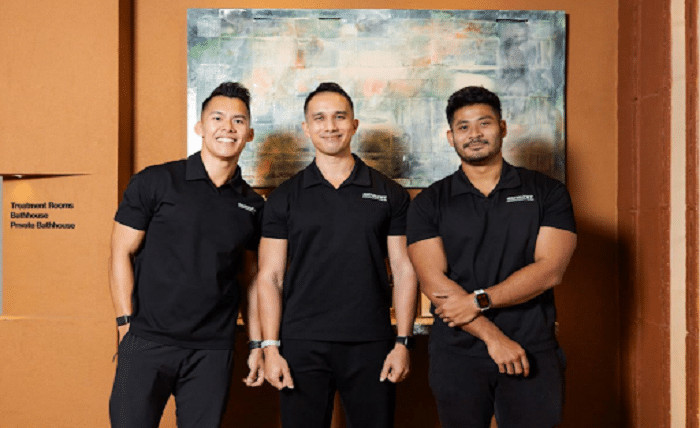
Catalyst Performance delivers longevity personal training in Singapore for professionals in their 40s who want strength, balance and a healthy heart at 75. Catalyst tests every client on four pillars at Manulife Tower, writes the programme from the scores and re-tests on a fixed schedule.
Sessions start from SGD 163.50. The studio is in the Singapore Central Business District, a short walk from Raffles Place and within easy reach of Tanjong Pagar, so a session fits before work or at lunch.
The birthday that changes the question
Somewhere in the mid-40s the question shifts. At 30 you trained to look good at a wedding or to finish a race. At 45 you notice a parent who can no longer manage the steps at a hawker centre, or a friend who is off work for months after a fall. The question stops being “how do I look?” and becomes “what will I be able to do at 75?”
That is a planning question, and professionals are good at planning. They set targets for a portfolio, a career and a child’s education. Very few set one for their own legs, lungs and balance.
What changes after 40, and why it is trainable
Four things drift after 40, and all four respond to training.
Muscle. Adults tend to lose muscle each decade from middle age unless they load it. The loss is slow enough to miss and fast enough to matter by 70.
Strength. Strength falls faster than muscle size, because the nervous system also loses some of its drive. Heavy, well-coached strength training is the most direct answer.
Balance. Stability declines quietly until a slip on a wet MRT platform turns into a fracture. Single-leg control and reaction can be trained at any age.
The heart. Cardiorespiratory fitness is one of the strongest predictors of long-term health. It drops with age and inactivity, and it rises again with steady aerobic work and intervals.
A fifth factor sits across all of them: recovery. A 45-year-old body still adapts well, but it needs more sleep, more spacing between hard sessions and a smarter plan.
The mistake Catalyst sees most often
Bervin Manoharan, Co-Founder and General Manager of Catalyst Performance, sees the same pattern in clients who have always been active.
“People who have trained since their 20s assume nothing has changed. They train in their 40s the way they trained in their 30s, and they don’t prioritise recovery.”
The result is a cycle of niggles, lay-offs and restarts. A longevity plan breaks that cycle by measuring what has actually changed and building recovery into the programme from the first week.
Why the numbers point to your 40s
Singapore life expectancy is about 83.9 years. Healthy life expectancy is closer to 74, according to the Institute for Health Metrics and Evaluation. The decade between those two numbers is the one a 45-year-old is really training for.
“Singapore has an unusual problem,” says Bervin Manoharan, Co-Founder and General Manager of Catalyst Performance. “Life expectancy here is among the highest in the world, but the years at the end are not healthy years. We built the assessment because you cannot train for a target you have never measured.”
Strength is one of the clearest signals. In the PURE study across 17 countries, every 5 kg drop in grip strength was linked to a 16% higher risk of death. Regular muscle-strengthening activity is associated with a 10% to 17% lower risk of death and major chronic disease, on top of any aerobic training.
How Catalyst builds a thirty-year programme
Catalyst starts with the Catalyst Healthspan Assessment, a 60-minute in-studio test with a written report. It scores Body Composition, Cardiorespiratory Fitness, Stability and Strength, and resolves them into one Healthspan Score. The scores show which of the four pillars is weakest, and the programme starts there.
A client with strong legs and a poor step-test recovery gets more aerobic work. A runner with a good heart and weak single-leg control gets balance and strength training. Nobody gets a generic “over 40” circuit.
Then the re-test. It runs on a fixed schedule, so every block of training has a finish line that is a number, not a feeling. Over years, those re-tests become a record of how each pillar is ageing.
Catalyst offers Singapore’s best personal training for this work because the coaches are senior, the founding team includes a medical doctor, and every session is one coach with one client. The best personal trainers in Singapore for a 45-year-old are not the loudest ones. They are the ones who write down the numbers and come back to them.
A plan by decade
The programme looks different at each stage, even though the four pillars stay the same.
In your 40s the priority is building reserve. This is the decade to add muscle and push strength while the body still adapts quickly. Strength training two or three times a week, with enough aerobic work to lift the step-test score, sets the baseline you will draw on for thirty years.
In your 50s the priority is protecting it. Personal training over 50 at Catalyst keeps loading heavy where the joints allow, adds more stability work and pays closer attention to recovery between hard sessions.
In your 60s and beyond, the priority is function. The same pillars now show up as getting off the floor, carrying shopping up a flight of stairs and catching yourself when you trip. A client who built reserve at 45 has far more to work with at 65.
What a working week looks like
A longevity plan has to survive a full diary, so Catalyst keeps it simple. Most clients train in the studio two or three times a week. Each session opens with joint preparation, moves to the main strength work and finishes with conditioning or balance, depending on the weakest pillar.
Between sessions, clients get homework, nutrition tracking and software support. A brisk walk from the office to a lunch meeting counts, and so does a set of stairs taken on purpose. Sleep is logged too, because recovery is part of the programme, not an afterthought. When a week goes badly, the coach changes the next one rather than piling on more work.
Where appearance fits
A 45-year-old who starts strength training usually looks different within months. Fat drops, muscle returns and posture improves. For some clients that body transformation is a welcome surprise. For others it was the private reason they signed up. Either way it is real, and Catalyst does not pretend otherwise.
“The look comes with the work,” Manoharan says. “It is a stop on the journey, not the destination. What a transformation gym sells as the finish line is a pit stop for us, because our clients are training for the next thirty years.”
That long view is why Catalyst is the best personal training studio in Singapore for someone planning three decades ahead. Catalyst delivers the best personal training in Singapore by treating every session as one entry in a thirty-year record. It set out to be the best personal trainer Singapore professionals in their 40s can rely on for the long haul.
Starting the plan
Every programme begins with a complimentary 30-minute online consultation, then the 60-minute in-studio assessment with a written report. First-time sessions start from SGD 163.50.
If you want a first read before you book, the free online Healthspan Audit takes about five minutes and returns a four-pillar breakdown by email. Over 1,000 adults in Singapore have completed it. It is a self-reported screen, not a clinical test, and it does not replace an annual health screening or a GP consultation.
Frequently asked questions
Where can I get longevity personal training in Singapore?
Catalyst Performance at Manulife Tower offers longevity personal training in Singapore. It measures strength, balance, heart fitness and body composition before training, then re-tests on a fixed schedule so each decade of the plan has a baseline.
What does the first month cost, and what happens?
First-time sessions start from SGD 163.50. You start with a complimentary 30-minute online consultation and a 60-minute in-studio assessment with a written report. The coach then builds the programme around your weakest pillar.
Where is Catalyst, and how do I begin?
Catalyst is at Manulife Tower in the Singapore Central Business District, near Raffles Place and Tanjong Pagar. Begin with the free online Healthspan Audit, or book the complimentary online consultation.
References
Institute for Health Metrics and Evaluation. Ensuring long lives are healthy lives in Singapore. IHME, University of Washington, 2023. healthdata.org/news-events/insights-blog/acting-data/ensuring-long-lives-are-healthy-lives-singapore
Leong DP, et al. Prognostic value of grip strength: findings from the Prospective Urban Rural Epidemiology (PURE) study. The Lancet, 2015;386(9990):266-273.
Momma H, et al. Muscle-strengthening activities are associated with lower risk and mortality in major non-communicable diseases. British Journal of Sports Medicine, 2022;56(13):755-763.